The Decision No One Is Accountable For
Why the selection decision is the most expensive blind spot in enterprise technology.
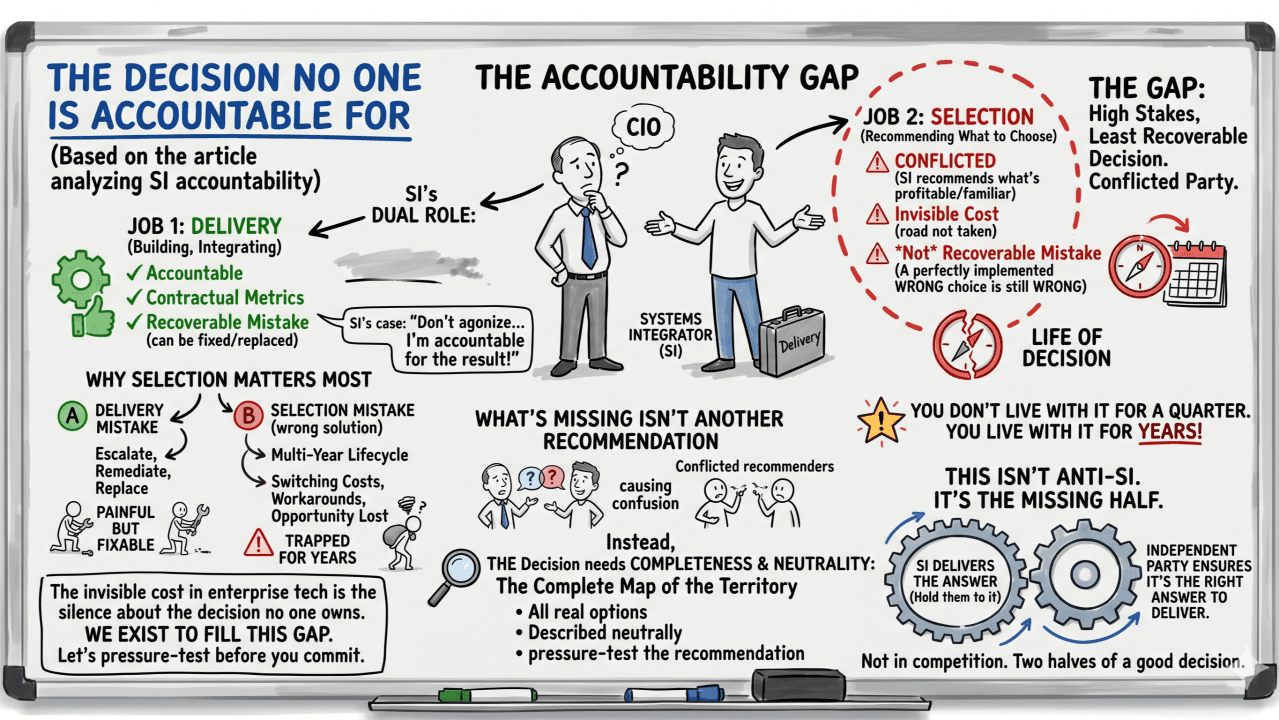
Your systems integrator will deliver the solution. But no one — not them, not anyone in the room — is actually accountable for whether it was the right solution to choose. That gap is quietly the most expensive thing in enterprise technology.
---
Sit in enough enterprise technology decisions, and you notice a strange thing about how trust gets distributed.
When a CIO brings in a systems integrator, the SI makes a reasonable and powerful case: "Don't agonize over every recommendation I make. I'm the one accountable for the result. I'll deliver this, end to end, and I'll be measured on whether it works." And that's true. The SI genuinely carries delivery accountability. If the implementation goes badly, there's someone to hold responsible, metrics to enforce, an escalation path.
So the CIO relaxes into it. The SI recommends a solution, the SI implements the solution, and the SI stands behind the outcome. Clean.
Except there's a decision hiding inside that arrangement that no one is actually accountable for. And it happens to be the most consequential one.
---
## Two different jobs, quietly bundled into one
The SI is doing two things that look like one thing.
The first is delivery — building, integrating, making the chosen solution work. Here their accountability is real and valuable. Hold them to it.
The second is selection — recommending which solution to choose in the first place. And here, something very different is going on. Because the SI typically recommends what they implement, what they have existing relationships with, what is profitable for them to deliver. Their recommendation isn't neutral; it's shaped by what's good for the SI. Most SIs will even tell you so, in their own way — "don't go solely by my recommendation" — which is a quiet admission that the recommendation is something you should be skeptical of.
So notice the asymmetry. The SI is accountable for delivery. The SI is conflicted on selection. And their accountability for the first is being used, subtly, to borrow your trust for the second.
"I deliver the result, so trust my recommendation" sounds like one statement. It's actually two — and only the first half is earned.
---
## Why the selection decision is the one that should scare you
Here's why this matters more than it first appears, and it comes down to what you can recover from.
A delivery mistake is recoverable. If the SI implements poorly, you can escalate, remediate, hold them to their contracted metrics, even replace them. Painful, but fixable. Their accountability is real precisely because the failure is correctable.
A selection mistake is not recoverable. If you were steered toward the wrong solution — the wrong platform, the wrong architecture, the wrong vendor for your actual use case — no amount of excellent delivery saves you. A perfectly implemented wrong choice is still a wrong choice. And you don't live with it for a quarter. You live with it for the entire multi-year lifecycle of that decision: the switching costs, the workarounds, the opportunity lost, the thing that never quite did what you needed.
So the highest-stakes, least-recoverable decision in the entire engagement — which solution to choose — is precisely the one where the accountable party is conflicted, and where their accountability doesn't actually extend. The SI is on the hook for delivering the answer flawlessly. No one is on the hook for whether it was the right answer.
That is the gap. And it's expensive in a way that rarely shows up on any invoice, because the cost of the road not taken is invisible.
---
## What's missing isn't another recommendation
The instinct, once you see the gap, is to want a second recommendation — another expert to tell you what to buy. But that just recreates the problem. Now you have two conflicted recommenders instead of one, and you're back to trusting someone's judgment about their own steer.
What the decision actually needs isn't another opinion. It's completeness and neutrality — the full, honest landscape of what exists for your specific use case, described without anyone grading it in their own favor, so you can judge whether the recommendation in front of you holds up against everything that's out there.
That's a different thing entirely. Not "here's what I think you should buy." Rather: "here's the complete map of the territory — every real option for your actual problem, described neutrally, including the ones your SI has no incentive to show you — so you can pressure-test the recommendation against reality and decide with full information."
The value is precisely that it comes from someone who doesn't implement and doesn't recommend. No implementation means no incentive to steer you toward what's profitable to build. No recommendation means no judgment of ours that you'd have to trust blindly. The only thing on offer is the complete picture — which is exactly what the selection decision has been missing.
---
## This isn't anti-SI. It's the missing half.
None of this is an argument against systems integrators. A good SI is genuinely valuable, and their delivery accountability is real — hold them to it, lean on it, value it.
It's an argument that delivery accountability and selection neutrality are two different jobs, and one party can't honestly do both. The SI delivers the answer. Someone independent should make sure it was the right answer to deliver. Those aren't in competition. They're two halves of a good decision, and most enterprises are only buying one of them — the half that happens to be conflicted on the part that matters most.
The CIOs who get this don't replace their SI. They add the missing half: an independent, recommendation-free read of the full landscape, used to pressure-test the recommendation before they commit to a choice they'll live with for years.
The SI delivers the answer. We make sure it was the right answer to deliver.
That second sentence is a job. Right now, in most enterprises, no one is doing it — and the silence about the decision no one owns is the most expensive in enterprise technology.
---