The practitioner intelligence thesis
The most valuable intelligence about how enterprises buy lives in the heads of the people who sell to them.
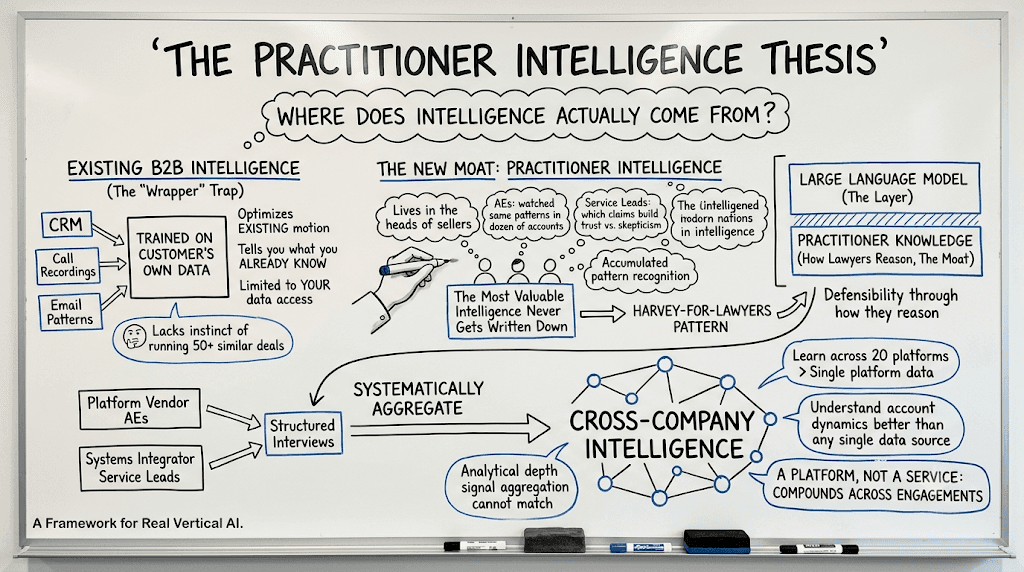
The practitioner intelligence thesis. Here's a question that separates real vertical AI from wrapper products: where does the intelligence actually come from?
Most B2B intelligence tools train on the customer's own data. Your CRM, your call recordings, your email patterns. Useful for optimizing your existing motion, but it can only tell you what you already have access to. It can't surface what someone who's run fifty similar deals knows instinctively.
The insight that took me a while to internalize: the most valuable intelligence about how enterprises buy lives in the heads of the people who sell to them. Account executives who've watched the same buying pattern play out across dozens of accounts. Service practice leaders who know which capability claims build trust and which trigger skepticism. The accumulated pattern recognition that never gets written down anywhere.
This is the Harvey-for-lawyers pattern. Harvey didn't just apply a language model to legal work — it built defensibility through the practitioner's knowledge of how lawyers actually reason. The model is the layer; the practitioner's intelligence is the moat.
For B2B technology buying, practitioner intelligence hasn't been systematically aggregated. The account executives at platform vendors, the service leads at systems integrators — they hold pattern knowledge across accounts that no single company's data contains.
Cross-company practitioner intelligence, aggregated through structured interviews, produces analytical depth that signal aggregation structurally cannot match. When you've learned how database buying decisions form across twenty platforms, you understand any single platform's account dynamics better than that platform's own data reveals.
The data isn't customer-specific. It's pattern intelligence that compounds across every engagement. That's what makes it a platform rather than a service.